essay · 15 March 2006
Before Philosophy Had a Name: The Presocratics and the Architecture of Thought
Nearly twenty years after first reading Kirk and Raven, the Presocratics still shape how I think about change, order, mathematical structure and the obligations of reason.
In conversation with G. S. Kirk and J. E. Raven, The Presocratic Philosophers
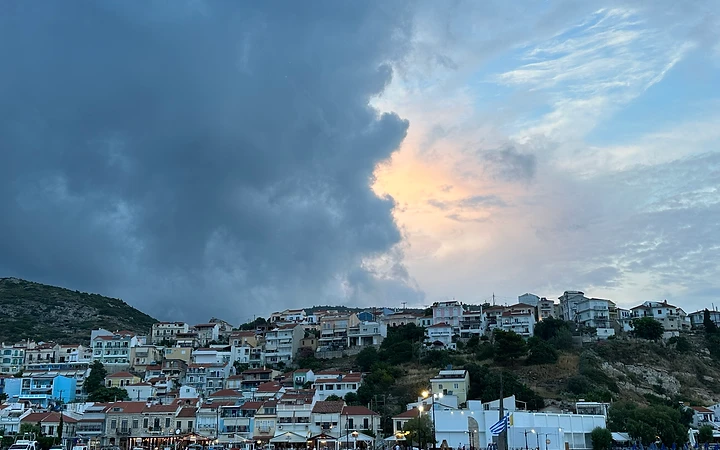
I read G. S. Kirk and J. E. Raven’s The Presocratic Philosophers in March 2006, when I was beginning seriously to study the history of philosophy. It is difficult for me now to separate what I learned from the book from the intellectual habits that followed it. Some books add information; a smaller number alter the categories through which later information is received. This was one of those books.
What struck me then, and still does, is the extraordinary density of invention compressed into the two centuries before Socrates. Questions that later philosophy would divide among metaphysics, cosmology, epistemology, mathematics, theology and ethics appear here while those disciplinary boundaries do not yet exist. The book itself begins before philosophy conventionally begins, with Greek cosmogony and its mythological antecedents, precisely because the transition is not a simple moment in which mythos suddenly disappears and logos replaces it. Kirk and Raven instead reconstruct a gradual transformation in which inherited stories about the generation of the gods and the world begin to be subjected to abstraction, generalisation and rational criticism. Their organisation makes this trajectory explicit: from the forerunners of philosophical cosmogony through the Milesians, Xenophanes and Heraclitus, then the Italian schools and Parmenides, and finally the pluralists and atomists who had to construct their systems in response to the Eleatic challenge.
That first transition remains important to me. Hesiod had already asked where the ordered world came from, but he answered genealogically. Chaos, Gaia, Ouranos and their descendants are simultaneously powers, persons and elements of the world. The earliest philosophers do not simply stop asking the old questions. They begin asking whether the answer has to take the form of a divine genealogy at all. Kirk and Raven are particularly cautious about exaggerating the break. Their preliminary discussion explicitly examines mythological ideas not because they are themselves philosophical, but because concepts expressed through myth could become the material upon which philosophical cosmology worked.
The Milesians are therefore more radical than their apparently primitive answers suggest. “Everything is water” sounds almost childish if it is treated as a failed scientific hypothesis. The intellectual revolution lies elsewhere. Thales is asking whether the immense multiplicity of experienced reality can be understood as transformations of something underlying it. The world ceases to require a separate divine biography for every phenomenon. It may have an intelligible unity.
Anaximander makes the move considerably more profound. The origin is no longer any familiar element such as water. It is the apeiron, the indefinite or boundless, from which determinate things emerge and into which they pass away. With him there also appears one of the earliest philosophical attempts to understand natural change through something like law: opposites encroach upon one another and “pay penalty and retribution” according to the ordering of time. The language remains poetic and juridical, but the idea underneath it is formidable. Nature is not merely a succession of happenings. Change has an order internal to reality.
This was one of the first ideas from early Greek philosophy that remained with me: explanation becomes powerful when it moves away from cataloguing events and begins looking for the structure that makes those events possible.
Anaximenes then makes transformation itself more intelligible by proposing rarefaction and condensation. Air does not merely sit underneath reality as a mysterious substance; differences of density generate differences in things. However inadequate the physics, the conceptual movement is recognisable even now: explain qualitative difference through an underlying process. One begins to see why the Milesians matter to the history of science. Their particular answers were mostly wrong. Their demand that nature should be intelligible through general principles was spectacularly fruitful.
Xenophanes introduced another principle that has never really left philosophy: suspicion of the gods we manufacture in our own image. Ethiopians imagine black gods with flat noses; Thracians imagine gods with blue eyes and red hair; if horses could paint, their gods would look like horses. The point is not merely comic criticism of anthropomorphism. It contains an epistemological warning. We project ourselves onto reality and then mistake our projection for knowledge.
His theology is correspondingly austere. The divine cannot simply be a larger version of a human personality moving about the world and behaving badly. More important for me is Xenophanes’ intellectual humility. Human beings may speak truly without possessing certainty that they have done so. There is a distinction between reality and our confidence in our representation of it. That sounds almost obvious after two and a half millennia of epistemology. It was not obvious then.
But it was Heraclitus who first made the world feel philosophically alive to me.
He is usually reduced to “everything flows”, and there is truth in the association with change, but it misses what fascinated me. Heraclitus is not simply saying that things change. He is asking how a world of incessant change can nevertheless constitute an ordered whole.
The answer is the logos.
People encounter a common order and yet live as though each possessed a private understanding. Reality is intelligible, but its intelligibility is not necessarily obvious. Heraclitus repeatedly forces us beneath appearances. “Nature loves to hide.” The visible opposition of things conceals a deeper unity.
This is why his river matters. The identity of the river does not exist despite the replacement of its waters. It exists through that replacement. Stability can consist in regulated change.
I think that insight has followed me more than I realised.
Organisations, institutions, societies and persons remain themselves while their constituent parts change. A system that never changes may cease to remain itself precisely because it has failed to reproduce the process that sustains it. Identity need not mean material immobility.
Heraclitus goes further. Opposites do not merely coexist. They constitute one another. Day and night, waking and sleeping, life and death, ascent and descent are intelligible through their relation. The bow and the lyre possess harmony because opposing tensions are held together. His “hidden harmony” is therefore stronger than visible agreement.
And then comes the disturbing proposition that strife itself belongs to order.
“War is father of all” is easily vulgarised into praise of violence. What I took from Heraclitus was something deeper: difference, opposition and tension are productive principles. A world from which all opposition were removed would not necessarily be harmonious. It might cease to possess the relations through which its order exists.
There is something almost dialectical here long before dialectic acquired its later philosophical forms. Contradiction cannot always be eliminated by choosing one side. Sometimes the phenomenon exists precisely because the opposition exists.
Pythagoras opened an entirely different door.
Here philosophy becomes inseparable from mathematics, music, cosmology and a way of life.
The discovery that musical consonances correspond to numerical ratios is one of those intellectual events whose strangeness is difficult to recover because its consequences became so foundational. An octave, a fifth and a fourth are experienced qualitatively as musical relationships, yet those relationships can be represented numerically.
Number therefore seems to disclose something beneath sensation.
The beautiful is not merely pleasant to the ear. Harmony possesses structure.
From there the Pythagorean imagination expands extraordinarily. Number, proportion, limit, order and harmony become principles through which reality itself can be conceived. The Greek word kosmos comes to carry precisely this sense of an ordered whole.
That connection between mathematical structure and reality has never ceased to astonish me. Modern physics is unimaginably more sophisticated than Pythagorean number mysticism, but the philosophical wonder underneath the enterprise is recognisably related: why should reality be mathematically intelligible at all? Why can structures conceived by thought correspond so powerfully to the organisation of nature?
Nearly twenty years after that first reading, the argument acquired an unexpected geography. In 2023 I travelled across the Dodecanese islands and visited Samos. Standing before the monument to Pythagoras, looking out across the water, I was deeply moved. The ideas I had encountered on the page in 2006 were suddenly joined to a place: an island, a horizon, a route across the Aegean. The interval between the reading and the journey made the association stronger rather than weaker. What had become part of my intellectual architecture almost two decades earlier appeared before me as memory, landscape and inheritance.
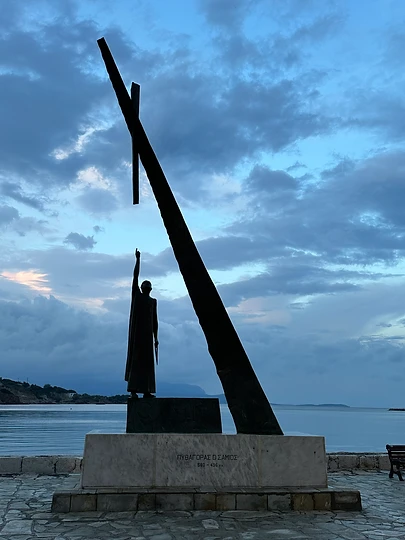

I remember the figure pointing upward beside the severe geometry of the monument and feeling, with unusual force, the continuity between an ancient act of wonder and the questions that had accompanied me since reading Kirk and Raven. It was not the illusion that a modern monument could recover the historical Pythagoras. It was the recognition that an idea first met in a book could remain dormant for years and then be awakened by a place.
Pythagoreanism also refused to separate intellectual understanding from the formation of the person. The doctrine of transmigration, ritual disciplines, communal rules and purification of the soul belonged to the same world as mathematics and musical proportion. Philosophy was not yet primarily the production of arguments by professional academics. It was a form of life ordered toward understanding.
That idea has remained important to me. What one believes about reality ought eventually to matter to how one lives.
And then there is Parmenides.
If Heraclitus made reality dynamic, Parmenides imposed upon thought an almost terrifying discipline.
His poem begins as revelation. A chariot carries the young thinker beyond the ordinary paths of men to a goddess who presents the possible ways of inquiry. The literary form remains archaic and religious, but what follows is one of the most radical exercises of pure reasoning in the history of philosophy.
Being is.
Non-being is not.
The statement appears trivial until Parmenides refuses to allow us to evade its consequences.
If something comes into being, from what does it come? If from being, then in some sense it already was. If from non-being, we have attempted to make what-is emerge from what-is-not. But nothing can meaningfully be said or thought about what-is-not without treating it as though somehow it were.
The trap closes rapidly.
Generation becomes unintelligible.
Destruction becomes unintelligible.
What truly is cannot have begun and cannot cease.
It cannot contain genuine gaps of non-being.
It cannot become something other than what it is.
Being therefore emerges as ungenerated, imperishable, continuous, indivisible and motionless.
The sensory world seems to tell us almost the exact opposite.
Things are born.
Things die.
They move.
They change.
They differ.
Parmenides nevertheless forces reason to ask whether perception can simply dictate ontology.
For me, that is his permanent achievement. He discovered that argument can compel us toward conclusions that experience does not want to accept.
After Parmenides, philosophy could no longer merely propose a cosmology. It had to explain how change was logically possible.
That is why the philosophers who follow him are so interesting. Empedocles, Anaxagoras and the atomists do not simply return to the Milesian project as though Parmenides had never happened. They accept important parts of his challenge and reconstruct change around them.
Empedocles denies absolute generation and destruction. The four roots remain, while Love and Strife combine and separate them. What ordinary language calls birth and death is actually mixture and dissolution. Parmenidean permanence is preserved at the level of the fundamental constituents while perceptible change is recovered at the level of their combinations.
Anaxagoras makes the problem still more intricate. Nothing simply comes from nothing. Everything is in everything, while Nous, Mind, initiates and orders the cosmic rotation that separates and organises the mixture. Here for the first time the ordering principle itself becomes explicitly intellectual.
Leucippus and Democritus produce perhaps the most elegant response.
Atoms are individually Parmenidean: ungenerated, indestructible and internally unchanging. But they move through void.
The intellectual audacity lies in rehabilitating precisely what Parmenides had forbidden. The void is in some sense “what is not”, yet without emptiness motion cannot occur. Reality can therefore consist of permanent beings moving and rearranging themselves within empty space.
Change is rescued without requiring the fundamental constituents themselves to change.
The implications stretch astonishingly far beyond ancient atomism. Once again, the specific physics is not modern physics. But the explanatory architecture is immediately recognisable: complex macroscopic change generated by the recombination and movement of simpler underlying units.
Looking back at this book twenty years after reading it, what surprises me is how much of my own thinking still moves between Heraclitus, Pythagoras and Parmenides.
From Heraclitus, I retain the conviction that change is not necessarily the opposite of order, that tension can generate structure, and that identity may reside in a pattern rather than in static components.
From Pythagoras comes the intuition that beneath qualitative appearances there may be relations, proportions and structures that are more fundamental than the things immediately presented to us, together with the older idea that intellectual order and the ordering of one's life ought not to be completely separate enterprises.
And from Parmenides comes perhaps the most severe lesson: thought has obligations. A proposition cannot be retained merely because experience, convention or desire makes it comfortable. Its consequences have to be followed.
I do not accept any of them as systems to which one could simply return. That would miss the point. What remains alive are the questions they made possible.
What does it mean for something to remain itself while changing?
Is opposition a defect in reality or one of the principles through which order emerges?
Why is nature susceptible to mathematical description?
What is the relation between appearance and what is?
What are we entitled to say about something merely because we can name it?
How far should reason be followed when its conclusions conflict with ordinary experience?
And perhaps most fundamentally: what kind of world must this be for it to be intelligible at all?
In March 2006 these were questions from a book I was reading while beginning the history of philosophy.
I did not realise that I was also acquiring part of the architecture through which I would continue to think.