essay · 15 June 2026
The City Inside the Organization: Plato’s Republic and the Politics of Institutions
Twenty years after first reading Plato’s Republic, its questions about function, authority, formation, incentives and institutional decline feel as relevant to organisations as they do to cities.
In conversation with Plato, Republic
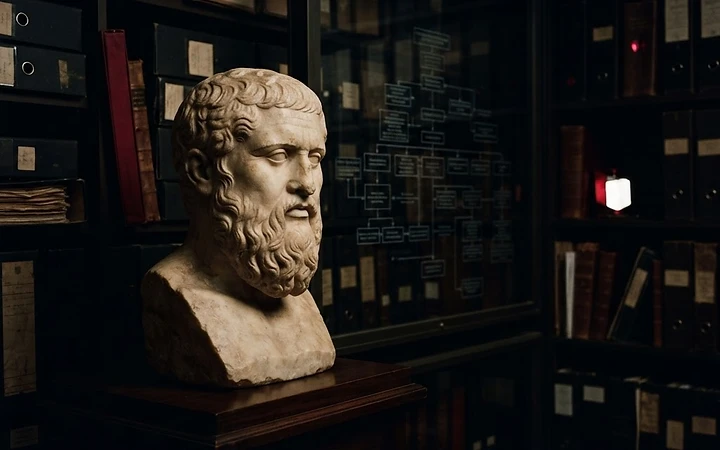
I read Plato’s Republic in June 2006, at the beginning of my study of philosophy. At the time I approached it mainly as political philosophy. Twenty years later, I find myself reading it differently. Its relevance is no longer confined, for me, to constitutions, rulers and cities. Much of what Plato describes is immediately recognisable in the internal political life of organisations: who performs which function, who acquires authority, what qualifies someone to exercise it, how people are formed before they are promoted, what narratives sustain collective cohesion, how incentives deform judgement, and what happens when an institution begins rewarding the wrong things.
The Republic begins from dependence. “Each of us isn’t self-sufficient but is in need of much” (Rep. 369b). A city exists because no individual can perform every necessary function alone. Plato therefore immediately moves from dependence to differentiation. “Each of us is naturally not quite like anyone else, but rather differs in his nature; different men are apt for the accomplishment of different jobs” (Rep. 370a-b). From there comes the famous principle that “one man, one art” produces the better result, and that each task is performed best when one person “does one thing according to nature and at the crucial moment” (Rep. 370b-c).
It is difficult for me now to read this without thinking about organisational design.
The first political problem inside an organisation is not ideology. It is function. Who should do what? What capabilities genuinely differ? Which tasks require depth rather than constant rotation? What happens when roles become titles rather than functions, or when prestige detaches from competence?
Plato’s answer is severe: disorder begins when functions cease to correspond to capacities.
This becomes explicit when justice is finally defined. Socrates says that justice consists in “the minding of one’s own business and not being a busybody” (Rep. 433a-b), and that in the well-ordered city “each one must practice one of the functions in the city, that one for which his nature made him naturally most fit.”
That formulation can sound authoritarian if removed from the argument around it. Applied more carefully, however, it contains a serious organisational principle: governance deteriorates when responsibility, competence and authority no longer line up.
I have seen how easily organisations create precisely this problem. Someone owns a process but lacks decision rights. Someone else has formal authority without operational understanding. A third person has technical knowledge but no access to the forum in which decisions are taken. A fourth intervenes because organisational visibility rewards intervention itself. Soon several people are “owning” the same issue while nobody is clearly accountable for the result.
Plato’s “minding one’s own business” is therefore less trivial than it sounds. It is an argument for functional clarity.
His corresponding definition of injustice is institutional interference. When people cross into functions for which they are not suited, “this change in them and this meddling are the destruction of the city” (Rep. 434b).
Translated into organisational language, the warning is familiar: duplication, unclear mandates, prestige-driven role expansion, committees without decision rights, managers overruling expertise they do not possess, specialists acting as executives, executives acting as specialists, and accountability diffused across structures designed precisely to avoid individual responsibility.
The most useful aspect of Plato’s model is that he does not think governance can be understood only through an organisation chart. The city is enlarged psychology. He builds the city in order to see the soul more clearly and then deliberately applies the result back to the individual. The just person and the just city must exhibit the same structure.
That analogy has stayed with me.
Institutions reproduce the incentives, desires and hierarchies of the people within them. Equally, institutions train people into particular kinds of behaviour. A competitive organisation produces competitive personalities. A fearful organisation produces defensive communication. An organisation that rewards visible activity over judgement eventually fills itself with visible activity. One that rewards escalation creates escalators. One that rewards ownership creates owners.
Plato’s tripartite soul becomes surprisingly useful here.
He distinguishes reason, appetite and thumos, the spirited element concerned with honour, anger, recognition and standing. The Leontius episode shows that the soul contains genuinely conflicting impulses: desire can pull toward one action while another part recoils from it.
In organisational life, thumos may be more important than appetite.
People do not act only for money or rational optimisation. They act for recognition, status, dignity, resentment, territory, professional identity and the fear of humiliation. Many apparently technical conflicts are therefore not technical at all. A disagreement over ownership may actually be a struggle over recognition. Resistance to a process change may concern status rather than process. An escalation may be formally about risk while psychologically about not being ignored.
Plato understood that a political system which accounts only for reason and appetite misunderstands human beings. Organisations make the same mistake whenever they treat people as bundles of incentives while ignoring prestige, belonging and honour.
The Ring of Gyges becomes even more interesting in this environment.
Glaucon asks what remains of justice when external accountability disappears. With the ring, a man can act invisibly, free from reputational or legal consequences. His claim is devastating: if both the just and unjust man possessed such power, “both would go the same way” (Rep. 360b).
The modern organisational equivalent is not invisibility in a magical sense. It is opacity.
What does a person do when nobody audits the decision? What happens when expertise creates an information monopoly? What happens when an executive possesses enough status that subordinates will not challenge him? What happens when a system is sufficiently complex that responsibility cannot be traced?
The Ring of Gyges is therefore a thought experiment about governance under conditions of asymmetrical visibility.
This leads directly to another line I find remarkably contemporary: “the extreme of injustice is to seem to be just when one is not” (Rep. 361a).
That is almost a definition of governance failure.
The dangerous organisation is not necessarily the organisation without policies, controls or values statements. It is the organisation in which the appearance of governance becomes separable from governance itself.
Controls can exist ceremonially.
Committees can meet without challenging anything.
Risk language can become ritual.
Values can become branding.
Reporting can become a substitute for observation.
Compliance with process can become more important than the outcome the process was created to secure.
Plato’s distinction between being and seeming should therefore be permanently uncomfortable to anyone working inside a complex institution.
The problem of the guardians takes this further. Who governs those entrusted with governing?
There is no infinite hierarchy. At some point a system reaches people whose decisions cannot simply be checked by another identical layer above them. Bloom captures the Platonic answer sharply: “there are no guardians above the guardians; the only guardian of the guardians is a proper education.”
This may be one of the strongest organisational lessons in the entire book.
Governance cannot ultimately be engineered exclusively through controls.
At the top of any sufficiently complex institution there are decisions for which no procedure can remove the need for judgement. Policy can constrain. Audit can detect. Committees can challenge. Delegations can structure authority. But eventually somebody must decide what something means, whether an exception is justified, whether a risk is tolerable, or whether a rule is being followed in substance rather than merely in form.
That is why leadership formation matters more than leadership certification.
Plato’s education of the guardians is not vocational training. It is an attempt to shape what they love, fear and admire before they acquire power.
His treatment of music is especially relevant here. Education includes rhythm, poetry, imitation and narrative because character is formed before reason becomes fully capable of examining what it has absorbed. Bloom notes that reason alone does not suffice in producing a good ruler and that it must be joined to a formative, non-rational element.
Modern organisations also educate through culture long before they educate through policy.
People learn by watching who is promoted.
They learn from what senior people tolerate.
They learn which errors are survivable and which are career-ending.
They learn whether dissent is rewarded in speeches and punished in meetings.
They learn whether accuracy matters more than speed, whether loyalty matters more than truth, whether mistakes should be surfaced or concealed.
Culture is therefore not a soft supplement to governance.
It is governance before governance becomes explicit.
The noble lie sharpens this further. Plato is willing to ask whether a political community can exist without common narratives that are not simply neutral descriptions of reality. Bloom refuses to sanitise this. “Socrates calls it a lie,” and the inhabitants of the city are meant to believe the founding story as true.
In organisations the equivalent is not necessarily deliberate falsehood. More often it is institutional mythology.
Every organisation tells stories about itself.
We are innovative.
We are conservative.
We always put the client first.
We are entrepreneurial.
We are meritocratic.
We are one team.
We empower people.
These statements may contain truth, aspiration, propaganda or all three simultaneously.
The Platonic question is not merely whether the narrative is factually correct. It is what the narrative does politically.
Whom does it legitimise?
Which behaviours does it make honourable?
Which contradictions does it conceal?
Which sacrifices does it persuade people to accept?
The moment one asks those questions, corporate culture stops being decorative language and becomes political theory.
The philosopher-king then becomes considerably less absurd than the caricature.
Plato’s proposition is not that academics should run institutions. It is that those exercising power should understand what power is for.
“Unless the philosophers rule as kings or those now called kings and chiefs genuinely and adequately philosophize, and political power and philosophy coincide,” the disorder of cities continues (Rep. 473c-d).
The organisational translation is not philosopher-CEO.
It is epistemic leadership.
A decision-maker should possess enough understanding to distinguish the objective from the metric, the process from the purpose, the model from reality, the immediate result from the systemic consequence.
This becomes especially important in large institutions because information becomes progressively abstracted as it moves upward.
The person performing the work sees the actual event.
The manager sees aggregated cases.
The executive sees a KPI.
The board sees a colour on a dashboard.
The higher the authority, the greater the risk that reality has already been converted into representation.
This is where the Cave becomes almost unnervingly applicable.
The prisoners “would hold that the truth is nothing other than the shadows of artificial things” (Rep. 515c).
The point is not that they are unintelligent. Quite the opposite. Plato explicitly imagines prestige attaching to the prisoner most skilled at predicting the shadows. He may be brilliant within the representational system.
That distinction matters enormously in organisations.
A dashboard may be accurate but incomplete.
A metric may improve while the underlying process deteriorates.
A report may become increasingly sophisticated while moving increasingly far from operational reality.
One can become extraordinarily competent at shadows.
Plato’s Cave is therefore a useful warning against confusing representational mastery with causal understanding.


The liberated person initially resists the real objects because the shadows are more familiar. When shown something closer to reality, he believes “what was seen before is truer than what is now shown” (Rep. 515d).
This is exactly what happens when new information disrupts an established institutional model.
Bad news is first treated as anomalous.
The person bringing it is questioned.
The measurement is challenged.
The methodology becomes the topic.
The organisation attempts to preserve the framework before reconsidering the framework itself.
The Cave is not merely about ignorance. It is about the psychological cost of model revision.
Plato’s conception of education follows. Education is not “putting sight into blind eyes” (Rep. 518b). It is “an art of this turning around” (Rep. 518d).
That distinction is central to serious organisational learning.
Training transfers procedures.
Education changes perception.
A trained employee knows which form to complete.
An educated practitioner understands why the form exists, when its assumptions fail, what downstream system depends upon it and what risk emerges if the rule is applied mechanically.
That is a much rarer capability.
Plato is equally sceptical of intelligence without orientation. He observes that the same sharpness of mind can become “useful and helpful or, again, useless and harmful” depending upon where it is directed (Rep. 518e-519a).
Organisations often confuse intelligence with judgement.
They are not the same.
An extremely intelligent person can optimise the wrong objective faster than everyone else.
A technically excellent team can perfect a process that should have been abolished.
An analyst can produce a beautiful model whose assumptions are false.
A manager can deliver every target while damaging the institution that generated those targets.
This is Platonic because the problem is teleological: toward what good is intelligence directed?
The philosopher is then required to return to the Cave. He is not permitted to remain in contemplation. Those who have understood something beyond the immediate system must “go down again among those prisoners” (Rep. 519d).
That is an unusually demanding conception of expertise.
Knowledge creates obligation.
The specialist who understands the system cannot simply complain that decision-makers fail to understand it. The burden includes translation.
Equally, leadership cannot simply remain at the level of abstraction. It must periodically descend into operational darkness, relearn what the work actually looks like and reconnect representations with causes.
The most striking line in the leadership argument comes soon afterwards: “that city in which those who are going to rule are least eager to rule is necessarily governed in the way that is best and freest from faction” (Rep. 520d).
I find this more persuasive the longer I observe organisational politics.
Ambition is not disqualifying. Institutions require people willing to assume responsibility. But appetite for authority is a dangerous criterion for allocating authority.
The strongest candidate for a leadership role is not necessarily the person who campaigns most successfully for it.
Visibility, political skill and organisational competence overlap only imperfectly.
Plato’s paradox is that leadership is safest when it is exercised by people who possess another source of value and identity outside the possession of office.
If authority becomes the principal good available to the leader, losing authority becomes existential.
That is when governance becomes personal.
Books VIII and IX make the organisational reading even clearer because Plato treats regimes as pathologies of dominant values.
Oligarchy elevates wealth.
Democracy elevates freedom.
Tyranny elevates unrestricted appetite.
The problem is not that wealth or freedom are false goods. It is that each becomes destructive when elevated into the single organising principle.
This maps directly onto institutions.
An organisation can optimise for growth until growth destroys quality.
It can optimise for efficiency until resilience disappears.
It can optimise for control until nobody exercises judgement.
It can optimise for autonomy until coordination collapses.
It can optimise for consensus until responsibility disappears.
It can optimise for speed until reflection becomes organisationally impossible.
Plato’s oligarchic city is especially recognisable when he says its rulers have “neglected everything except money-making” (Rep. 556c).
The sentence is not interesting because profit is intrinsically suspect. It is interesting because Plato is describing institutional monoculture. Once one metric becomes the universal measure of success, everything difficult to represent in that metric begins to disappear from governance.
His democracy is even more subtle.
It is “full of freedom and free speech” (Rep. 557b) and appears “like a many-colored cloak decorated in all hues” (Rep. 557c).
Plato understands its attraction.
The danger enters when equality among persons becomes equality among every desire, every judgement and every standard. The democratic soul “dishonor[s] none but foster[s] them all on the basis of equality” (Rep. 561b), refusing to recognise that some desires may be better than others.
There is a powerful organisational analogy here.
Healthy organisations distribute voice widely.
Unhealthy organisations confuse voice with authority.
Not every opinion carries equal epistemic weight on every subject.
Expertise matters.
Responsibility matters.
Evidence matters.
The challenge is therefore to preserve openness without dissolving distinctions of competence.
This is one of the hardest governance problems in modern organisations because inclusion and hierarchy are both necessary. Plato is valuable precisely because he refuses to pretend that the tension disappears.
The final degeneration into tyranny follows from excess. Democracy identifies freedom as its greatest good, but excessive pursuit of that good destabilises the regime itself (Rep. 562b-c).
The broader principle is more important than the constitutional claim: every governing value contains a pathology when pursued without counterweight.
Good governance therefore requires balance among goods rather than maximalisation of one.
The Myth of Er then returns the whole argument to individual responsibility.
“A demon will not select you, but you will choose a demon” (Rep. 617e). “The blame belongs to him who chooses; god is blameless.”
The souls choose their next lives, and some choose disastrously because they have not learned to recognise what apparently attractive lives will do to them. Socrates therefore says that the essential study is learning to “distinguish the good and the bad life” and “choose the better from among those that are possible” (Rep. 618c).
This is where the Republic becomes most contemporary for me.
Organisational politics is ultimately made of choices.
Which promotion do I want?
Which responsibility should I accept?
Which compromise is tolerable?
Which hierarchy deserves loyalty?
Which conflict is worth having?
When should I obey?
When should I challenge?
When should I leave?
What kind of person will success in this environment require me to become?
The most important question is therefore not simply whether an organisation is well governed.
It is what kind of soul its governance produces.
That may be the most useful way I now read the Republic. Plato taught me that institutions cannot be understood through structures alone. Their real constitution is distributed across incentives, education, prestige, narrative, expertise, habit and the kinds of people their internal politics selects for advancement.
An organisation becomes what it rewards.
A hierarchy becomes what it promotes.
A culture becomes what it tolerates.
And governance fails long before the formal structure notices, whenever appearance begins to separate from reality, authority from competence, or power from an intelligible account of the good.