essay · 20 September 2026
The Discipline of Truth: What Thomism Taught Me About Study
Sertillanges taught me that serious thinking is not merely intelligence, but a discipline of attention, humility, method, memory and submission to truth.
In conversation with A. G. Sertillanges, The Intellectual Life
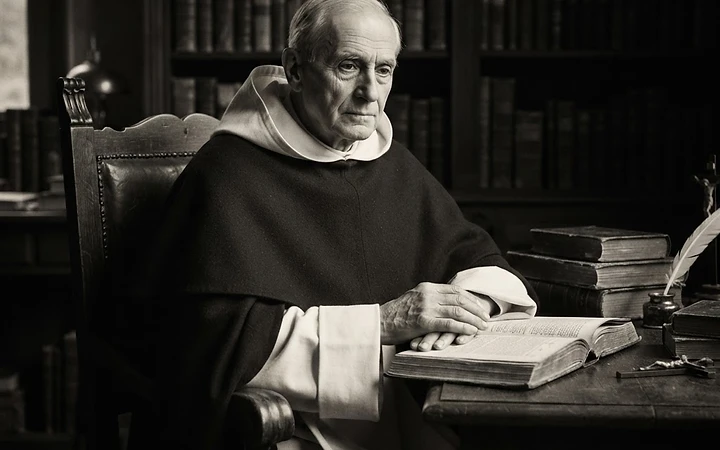
I read A. G. Sertillanges O.P.’s The Intellectual Life in the context of my Thomistic education that taught me something I have never really lost: serious thinking is not merely a matter of intelligence. It is a discipline of the whole person.
That distinction mattered enormously to me. One can be clever and intellectually careless. One can read widely and think badly. One can accumulate astonishing quantities of information while lacking order, method, patience or submission to evidence. The Thomist tradition in which I was taught treated study more severely. Intellectual work required habits. Attention had to be trained. Arguments had to be followed to their consequences. Terms had to be defined. Sources had to be understood before being criticised. One had to learn when to speak, when to investigate further, when to admit ignorance, and above all when reality had defeated one’s preferred conclusion.
Sertillanges expresses this almost from the beginning. An intellectual vocation, he says, is not fulfilled by “vague reading and a few scattered writings.” It requires “penetration and continuity and methodical effort.”
That combination of penetration, continuity and method still describes what I understand by serious study.
The word continuity is particularly important. Intellectual life is not produced by occasional bursts of enthusiasm. Sertillanges is wonderfully severe about this:
“The life of study is austere and imposes grave obligations. It pays, it pays richly; but it exacts an initial outlay that few are capable of. The athletes of the mind, like those of the playing field, must be prepared for privations, long training, a sometimes superhuman tenacity. We must give ourselves from the heart, if truth is to give itself to us. Truth serves only its slaves.”
I would probably phrase the theology differently today in some contexts, but I recognise the discipline completely. Knowledge has a price. Understanding does not appear simply because one is interested in a subject. There is a difference between attraction to an idea and submission to the labour necessary to understand it.
That was one of the great lessons of my Thomist teachers. Intellectual seriousness begins when curiosity accepts discipline.
Sertillanges repeatedly insists that desire for knowledge must be accompanied by acceptance of the means by which knowledge is acquired. Many people would like to know; considerably fewer are willing to read slowly, return to difficult passages, learn languages, follow references, reconstruct an argument fairly, discover that an objection has already been answered, or spend hours discovering that their original intuition was wrong.
His formulation is characteristically unsentimental:
“Many people would like to possess knowledge! A vague aspiration turns the eyes of the multitude towards horizons that the greater number admire from afar off... To get something without paying for it is the universal desire; but it is the desire of cowardly hearts and weak brains.”
The language is harsher than I would normally use, but the underlying proposition remains true. Intellectual work has costs, and there is no serious method that abolishes them.
This became especially important to me in learning concentration.
Sertillanges compares attention to a lens. Diffused light warms little; concentrated light can ignite. He therefore writes:
“Let your mind become a lens, thanks to the converging rays of attention; let your soul be all intent on whatever it is that is established in your mind a dominant, wholly absorbing idea. Make an orderly series of your different studies, so as to throw yourself into them completely. Let each task take entire hold of you, as if it were the only one.”
This is one of the passages that most closely resembles the practical intellectual habits I learned from Thomists.
Concentration is not simply avoiding distraction. It is giving an object enough uninterrupted attention for its internal structure to become visible.
There is a point in difficult study before which one is merely looking at information. Then, after sufficient sustained attention, relationships begin appearing. Definitions connect. Earlier premises explain later conclusions. An apparent contradiction resolves because one notices a distinction one had initially ignored. The subject begins to acquire architecture.
That does not normally happen in fragments of attention.
Sertillanges continues:
“When the turn of one comes, we must put the other aside, set up a system of watertight compartments, work intensively at the point we are engaged on and not change to another until afterwards. Doing a bit here and a bit there is never any good.”
I recognise this principle everywhere in my own intellectual life. I may have many interests, sometimes excessively many, but when I genuinely want to understand something I need to enter it almost monastically for a while. The broader range is valuable only if individual subjects are sometimes permitted to become exclusive.


This leads to another Thomist lesson that has stayed with me: breadth and superficiality are not the same thing.
Sertillanges writes:
“The half-informed man is not the man who knows only the half of things, but the man who only half knows things. Know what you have resolved to know; cast a glance at the rest.”
I love that distinction.
No human being can know everything. Serious intellectual life therefore requires sacrifice. Choosing one field means neglecting thousands of others. A broad mind is not one that pretends to mastery everywhere. It is one that knows where it has depth, where it has orientation, and where it is simply ignorant.
Sertillanges puts this plainly:
“Do not be ashamed not to know what you could only know at the cost of scattering your attention. Be humble about it, yes, for it shows our limitations; but to accept our limitations is a part of virtue.”
That remains an important discipline in an age in which information is abundant enough to make superficial familiarity feel like competence.
The harder lesson, however, is not concentration. It is submission to truth.
This is probably the most distinctly Thomist element in the book.
Sertillanges writes:
“There is something else still more important, namely, to submit not only to the discipline of work, but to the discipline of truth. This submission to truth is the binding condition for communion with it.”
For me, that sentence contains almost the whole intellectual ethic.
The purpose of study is not to become better at defending what I already believe.
It is not to accumulate ammunition.
It is not to perform intelligence.
It is to place the mind under an obligation to what is.
That sounds elementary, but it is extremely demanding in practice because the mind is exceptionally talented at defending itself. We prefer evidence that confirms our expectations. We become attached to conclusions because they are ours. We mistake consistency with our previous opinions for truth.
Sertillanges is explicit:
“By thought we find things; we do not make them.”
That is perhaps the simplest formulation of intellectual realism I know.
Reality is not obliged to conform to the elegance of my theory.
Evidence does not become false because it is inconvenient.
An argument does not become weak because I dislike its conclusion.
If I discover that I am wrong, the defeat belongs to the proposition, not to me.
This is where intellectual humility becomes something much more rigorous than modesty.
Sertillanges writes:
“Intellectually, pride is the father of aberrations and of artificial and pretentious productions; humility is the eye which reads in the book of life and in the book of the universe.”
Humility in study is therefore epistemic rather than social. It means allowing the object to correct the observer.
That was something my Thomist teachers were very good at teaching through method. A proposition had to be formulated accurately before it could be disputed. The strongest objection deserved an answer, not the weakest available caricature. Authorities mattered, but an authority had to be understood in context. Distinctions mattered because apparently contradictory statements could refer to different senses of a term.
And when the evidence was insufficient, the correct answer could simply be: I do not know.
There is another passage in the preface that I find exceptionally important:
“Never ignore, never refuse to see what may be thought against your own thought... How often one would like to evade a difficulty, to be satisfied with an error, unduly to prefer one’s own opinion! Severity with oneself, so favorable to rightness of thought, so helpful in safeguarding it against the thousand dangers of research, is heroism.”
That is rigorous thinking in its most practical form.
Before asking whether the opposing argument is wrong, ask whether I have understood it.
Before publishing a conclusion, ask what evidence would disprove it.
Before rejecting an objection, ask whether it exposes a weakness I would prefer not to see.
Before declaring a question settled, ask whether I am genuinely convinced or merely tired of investigating.
That discipline is extremely close to what I value now in analytical work.
Sertillanges also gave me a way to understand reading itself. Reading is not consumption. The objective is not to maximise the number of books crossed off a list.
The book’s table of contents is already provocative: under “Preparation for Work” appears the instruction “Not Reading Much.”
That principle is easy to misunderstand. It is not an argument for ignorance. It is an argument against substituting intake for assimilation.
The purpose of reading is to think.
A book should leave behind an organised residue in the mind.
This connects to Sertillanges’ extraordinary discussion of memory. He rejects accumulation without structure:
“One’s memory must not be chaos. Science, scientia, is knowledge through causes; the worth of every experience depends on its connections, its grouping with other experiences, its place in a graded scale of values. Merely to accumulate recollections is to make them all unusable and inevitably to recover them only by chance.”
This is almost exactly how I now think about knowledge management.
A collection of facts is not yet knowledge.
Knowledge appears through relationships.
What causes what?
What depends on what?
Which concept is general and which particular?
Which rule explains several apparently unrelated cases?
What is foundational and what is derivative?
Sertillanges continues:
“Look always for what connects this thing with that, what conditions are necessary for this and for that; let this coordination, and not scattered fragments, fix itself in your memory.”
This is one of the most useful pieces of intellectual advice I have ever encountered.
I no longer try primarily to remember isolated information. I try to remember structures.
Once the structure exists, facts acquire places within it.
Without the structure, one simply has a warehouse.
Sertillanges says this almost brutally:
“Fifty data are no better than one, if they all stand only in the same relation to the fundamental idea; uncoordinated they remain fruitless.”
The contemporary relevance is obvious. We live with unprecedented access to information and therefore with an unprecedented temptation to confuse information abundance with understanding.
The intellectual task becomes increasingly one of organisation, hierarchy and connection.
This is also why the Thomistic rules for memory are so practical. Sertillanges summarises four: put what is to be remembered in order, attend to it deeply, return to it repeatedly, and reconstruct it through chains of association.
He then turns that into a study method:
“When you read or listen with a view to learning, be wholly present and concentrated... Be ready, as soon as you have read or heard the thing, to repeat it exactly in as far as you want to fix it in your memory. If it is a book, do not leave it without being able to sum it up and to estimate its value.”
That is a much higher standard than simply finishing a book.
Could I explain its argument?
Could I distinguish its central claim from its supporting material?
Could I say where it is strongest?
Where does it depend upon assumptions?
How does it relate to what I already know?
What changed in my thinking because I read it?
If I cannot answer those questions, reading may have occurred but study has not.
The same principle appears in note-taking. Sertillanges warns against indiscriminate extraction:
“Some people have so many and such full notebooks that they are prevented by a sort of anticipatory discouragement from ever opening them. Their imaginary treasures have cost much time and trouble, and they yield no return.”
His solution is excellent:
“Keep notes made after thinking, and with moderation.”
That sentence could be written above every note-taking application ever designed.
Capture is not understanding.
A note is valuable because of the intellectual operation that produced it, not because information has been successfully copied from one container into another.
The discipline extends into time.
Sertillanges describes study as “a prayer to truth” and then argues that serious intellectual life continues outside formal hours of study. The point is not that one must consciously work every minute. It is that sustained intellectual attention gradually changes what one notices.
He writes:
“The important thing for the man of truth is to understand that truth is everywhere, and that he is allowing a continuous stream to pass by him which might set his soul working.”
This describes something I recognise very strongly. Once a problem genuinely occupies the mind, apparently unrelated things begin connecting to it. A conversation, a historical example, an organisational failure, a technical standard, a sentence in a novel, a building, a journey, can suddenly clarify something one had been studying elsewhere.
Sertillanges therefore tells the intellectual to learn to look:
“Do not see in a town merely houses, but human life and history... Let travel tell you of mankind; let scenery remind you of the great laws of the world... and let the least contact with your fellows throw light on the highest conception of man.”
This is one of the passages I find most beautiful because it prevents discipline from becoming narrowness.
Rigorous thought does not mean retreating permanently from reality.
Reality is the material.
The discipline consists in learning how to see it.
And then there is patience.
Sertillanges understands that serious thought has its own temporality and cannot always be accelerated. He writes:
“By respecting the laws of birth and development, and by not insulting knowledge through ill-judged hurry, you will gain more than by a headlong rush.”
And then:
“Avoid the fuss and flurry of the man who is pressed for time. Hasten slowly. In the realm of mind, quietness is better than speed.”
I still need this lesson.
Modern work rewards immediacy. Messages arrive continuously. Analysis is expected quickly. Information can be retrieved instantly. Generative systems can produce pages before one has completely formulated the question.
But retrieval is not judgement, and speed is not depth.
Some ideas require incubation.
Some contradictions should not be resolved prematurely.
Sometimes the correct analytical move is to remain with a problem until its structure becomes clearer.
Persistence then becomes inseparable from patience:
“To persevere is to will; he who does not persevere does not will, he only plans.”
There is a great deal in that line.
Intentions are intellectually cheap.
Plans are cheap.
Beginnings are cheap.
Completion is evidence of will.
Sertillanges therefore treats unfinished work almost morally:
“Every beginning is a promise.”
And shortly afterwards:
“You have said: ‘I will do this,’ do it.”
That principle, too, has stayed with me. The habit of finishing is not simply productive. It trains judgement. Completion forces decisions that indefinite preparation allows us to postpone. A finished argument must finally state what it claims. A finished analysis must distinguish essential from incidental. A finished piece of work exposes itself to criticism.
Sertillanges even recommends returning to completed work with a “hostile eye”, borrowing the story of Titian putting paintings aside until he could see them almost as though they had been made by someone else.
That distance is indispensable.
The first draft belongs partly to enthusiasm.
Revision belongs to judgement.
Perhaps the most compact summary comes near the end of his treatment of work:
“Success in every order is always attained on the same conditions: to reflect at the start, to begin at the beginning, to proceed methodically, to advance slowly, to give out all one’s strength.”
I recognise my Thomist teachers in that sentence.
Begin at the beginning.
Define terms.
Establish premises.
Distinguish what is known from what is inferred.
Read the source.
Follow the argument.
Do not skip the objection.
Do not pretend certainty.
Do not confuse quantity with depth.
Do not hurry because the conclusion is attractive.
And when reality contradicts you, yield.
That is probably the deepest intellectual habit I received from them.
Not what to think.
How to place thought under discipline.
And perhaps above all, how to understand that intellectual rigor is not coldness. Sertillanges repeatedly describes the intellectual life in the language of love, vocation and service. The point of discipline is not to make thought mechanical. It is to remove what prevents the mind from giving itself completely to its object.
Twenty years later, that remains very close to my own ideal of study: wide curiosity governed by concentration, confidence restrained by humility, memory organised by structure, argument disciplined by evidence, and an absolute willingness to prefer what is true to what I would have liked to be true.