essay · 20 September 2026
The Order of Being: A Thomistic Grammar of Reality
A reflection on the Thomistic architecture of reality: being before thought, act and potency, form and matter, participation, causality, freedom and the good.
There is one intellectual instinct that precedes almost everything else in how I think: reality comes first.
Thought does not manufacture being. Language does not constitute the real. A theory does not acquire truth from coherence, usefulness, beauty or consensus alone. The intelligence is answerable to something outside itself, something that was there before I began to think and will remain there if my reasoning fails. The first duty of thought is therefore receptive before it is constructive.
This is what I find so profoundly liberating in Thomism. It places the intellect in the world without either imprisoning it within sensation or allowing it to become sovereign over reality. It rejects both naïve materialism and the temptation to make the world dependent upon the categories of the knowing subject.
Sertillanges captures Saint Thomas’s intellectual temperament beautifully. Thomas does not continually insert himself between the reader and the thing being investigated. He is concerned with the object.
“Saint Thomas explains and proves; but he never ‘asserts’, still less does he ‘declare’. He says: this is necessary; this is impossible; or else: it seems. But such formulas are, in his thought, the expression of a relation among things, not of a relation between truth and himself. Expressions so common among us, ‘I believe’, ‘I consider’, ‘I am persuaded’, are foreign to him; he gives no weight to a merely personal idea.”
And Sertillanges draws the methodological principle from this:
“He pursues the unison of thought and being, an eminently impersonal effort, a universal task... It is the real that is intelligible, not professorial pretension. Facts speak; ‘Wisdom cries aloud’; a pedant must not interpose himself.”
That is close to my own ideal of intellectual work. The aim is not originality for its own sake. It is conformity of mind to reality. Originality, when it comes, should be the consequence of seeing something truly, not of arranging oneself theatrically in opposition to everyone who came before.
Being is prior to our systems
Sertillanges begins his exposition of Thomistic philosophy with the relation between being and knowledge because almost everything else depends upon it. The world initially presents itself as multiplicity. Things differ, change, emerge, vanish, act upon one another and participate in innumerable relations. The intellect nevertheless seeks intelligibility within that multiplicity.
His description of this appetite for unity is one of the passages I particularly like:
“Our effort, modest in appearance but in reality identical with the deepest ambition of knowledge, is to bring the world back to its perfect unity, while nevertheless grasping it in all its values and all its shades of beauty, and to relate it to its God.”
This is a specifically Thomistic kind of synthesis. Unity does not require flattening difference. To understand is not to reduce everything to one crude explanatory substance. The whole attraction of Thomism lies in preserving distinctions while locating them within an intelligible order.
Matter is real. Form is real. Quantity is real. Quality is real. Efficient causality is real. Finality is real. Sensation is real. Intellectual abstraction is real. The body is real. The soul is real. Contingency is real. Providence is real.
One does not solve a metaphysical difficulty by abolishing one side of it.
That habit of distinction has remained fundamental to me. When two apparently contradictory propositions confront one another, the first question should often not be “which one is false?” but “in what respect is each being asserted?” Thomism repeatedly refuses false alternatives by showing that apparently opposed claims concern different levels, causes or modes of being.
Act and potency: reality as structured becoming
The distinction between act and potency is one of the most fertile intellectual instruments I have ever encountered.
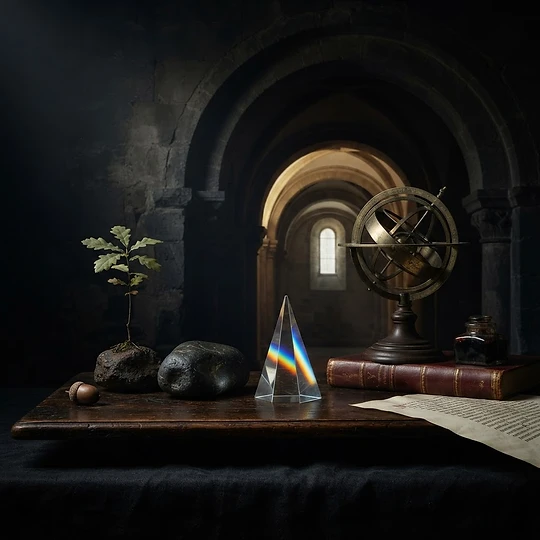
Change is real. Yet if change is intelligible, the thing changing cannot simply be pure indeterminacy. Something actual possesses a capacity for another actuality. The acorn is not actually an oak, but neither is its possibility of becoming an oak equivalent to its possibility of becoming a whale. Potency is already structured by what the thing is.
This gives becoming metaphysical intelligibility.
It also prevents the world from being conceived as a sequence of disconnected states. Reality contains capacities, tendencies and fulfillments. A thing may be understood partly through what it presently is and partly through what its nature allows it to become.
This is why form and matter cannot be collapsed into one another. Sertillanges explicitly rejects the temptation, already strong in the mechanistic philosophies of his own day, to reduce every qualitative transformation to mere displacement and quantity:
“Saint Thomas rejects this impoverishment of being and this false simplification issuing from the mathematical spirit. Natural qualities presuppose mechanical movement, but they do not coincide with it... The mechanical effect is here only the means, the occasion, or the result of an interior metamorphosis, one that is qualitative, formal, in short, belonging to the order of intelligibility.”
I find the principle more important than any obsolete scientific vocabulary surrounding it. Explanation at one level does not automatically eliminate another level.
To explain the biochemical processes of life is not thereby to have explained organism as organism. To describe neuronal events is not yet to have exhausted thought as thought. To quantify a phenomenon is not necessarily to have identified its form.
Reduction can illuminate. Reductionism can blind.

Form is not decoration added to matter
The hylomorphic insight goes deeper. Form is not a shape externally stamped onto passive stuff. It is the principle by which a thing is the kind of thing it is.
Matter and form are therefore not two objects placed beside one another. They are principles of one concrete being.
This is especially important in understanding life. A living organism is not, in the Thomistic view, a machine occupied by a ghost. Nor is consciousness merely a curious secretion of sufficiently complicated matter. The living being is one substance.
That principle becomes decisive in anthropology.
Sertillanges writes:
“Man is ‘neither angel nor beast’; he is neither an incarnate angel nor a beast that has arrived at a higher stage, but a mixed nature, a composite nature, possessing as such its own ontological style and revealing through its operations a character proper to itself, irreducible to its elements.”
That sentence could stand against two perennial errors.
The first spiritualises man until the body becomes an inconvenience attached to the true self. The second materialises man until reason, freedom and intellectual life must somehow be explained away as sophisticated epiphenomena.
Thomism permits neither.
I am embodied all the way into the operations through which I come to know the world, yet I am not intelligible merely as matter.
Knowledge begins in the senses, but does not end there
One of the principles I find most congenial in Thomas is omnis cognitio a sensu: human knowledge begins with sense experience.
There is nothing anti-empirical about Thomism.
Sertillanges puts it forcefully:
“We know through the body not only matter, but spirit; for every idea, even the idea of God, has its first origin in the universe, which comes to us through the filtering of the senses.”
This disciplines speculation. We are not angels. Human intelligence does not begin with direct intuition of essences detached from matter. We see, hear, touch, remember, imagine and compare. Intellectual knowledge begins in this embodied encounter with particulars.
But the intellect does something sensation alone cannot do.
It apprehends the universal.
Sertillanges describes abstraction as an intellectual return from realised form to intelligible form:
“Intellectual knowledge consists in recovering being at its point of departure, before its individuation in things. Coming too late for this, we move backward; we disengage the idea from the being that embodies it; we ascend from the realised idea to the idea of realisation, from the house to the plan, from the work of art presented to us by nature to the art according to which nature creates it, directs it and urges it toward its term.”
That is one of the most beautiful descriptions in the book.
When I understand triangularity, humanity, causality or justice, I am not simply storing a faded composite image of many triangles, humans, causes or just actions. The intellect has grasped something capable of being predicated universally.
Here again Thomism occupies a middle position I find remarkably stable. Knowledge is grounded in reality without being reduced to sensation. Intellect transcends the sensible precisely by working upon what sensation has given it.
Truth is adequation, not self-expression
From this follows a principle that governs almost everything else: truth is fundamentally the agreement of intellect and thing.
The mind is successful when its judgement corresponds to what is.
This is why Thomistic intellectual humility is not timidity. It is realism.
I am entitled to confidence when the reasons warrant it. I am obliged to revise when reality warrants that. Neither stubbornness nor permanent scepticism is a virtue.
The objective is not to possess my own position more securely. It is to become more securely possessed by what is true.
This is also why Saint Thomas can appropriate Aristotle, Augustine, Avicenna, Dionysius and others without intellectual insecurity. Truth does not become contaminated because an opponent discovered part of it.
The question is simply whether it is true.
That catholicity of intelligence may be one of the most important Thomistic habits I retain. Intellectual traditions are not tribal territories. A proposition is not refuted by discovering its genealogy. Nor is an argument established by discovering respectable ancestry.
The object judges us all.
God is not another being within the inventory of beings
Thomistic theism begins to become intellectually serious when one stops imagining God as the largest object in the universe.
God is not a particularly powerful instance of the category “being”.
The movement of the Five Ways is from participated, dependent and actualised being toward that which does not receive existence as something distinct from itself. The culmination is not one more cause inserted into an otherwise complete causal system, but the ultimate source upon which there being a causal order at all depends.
Sertillanges repeatedly returns to this. The whole of Thomism can be read, in a sense, as a doctrine of participation: finite beings possess actuality without being actuality absolutely. They have being. They are not Being itself.
Hence the metaphysical importance of divine simplicity and pure act.
In creatures, actuality is received and limited. There is what a thing is and that it is. There are capacities not yet actualised. There are compositions, dependencies and determinations.
In God, these divisions cannot apply in the same manner.
This also changes how theological language must work.
Analogy: neither anthropomorphism nor silence
We speak of God, but neither univocally nor equivocally.
If “good”, “wise” or “being” meant exactly the same thing when said of God and creatures, God would be dragged inside creaturely categories. If the words meant something completely unrelated, theology would say nothing at all.
The answer is analogy.
Created perfection genuinely tells us something about its source, but the mode in which that perfection exists in God infinitely exceeds its creaturely mode.
This principle has implications well beyond theology. Analogy trains the mind to resist the demand that every meaningful predicate must be either identical in meaning or entirely equivocal.
Reality contains proportion.
That seems to me a crucial intellectual habit. Not every resemblance is identity, and not every difference is absolute discontinuity.
Creation means dependence in being, not merely a first event
One of the most sophisticated Thomistic distinctions in Sertillanges’ treatment concerns creation.
Creation is not primarily an answer to the question, “What happened at the first moment?”
It is an answer to the question, “Why does anything exist at all?”
Consequently, creation and temporal beginning are distinct questions.
Saint Thomas accepts on faith that the world had a temporal beginning, but he does not pretend that philosophy proves it. An eternally existing created universe would still be created because creation concerns dependence upon God for being, not simply chronological priority.
This distinction fascinated me when I first encountered it and still does because it shows Thomas refusing to make philosophy perform work that belongs to revelation.
One can believe more than one can demonstrate while remaining extremely precise about which is which.
That distinction between what reason establishes and what faith receives is not an embarrassment to Thomism. It is part of its intellectual discipline.
Creation is therefore not a divine intervention occurring once at the left edge of a timeline. Created being is dependent being.
Were the First Cause merely to have initiated the cosmos and withdrawn, the Thomistic meaning of creation would have been missed almost completely.
Providence does not abolish secondary causality
The same precision applies to divine government.
Providence does not mean that created causes are unreal because God is the First Cause.
On the contrary, genuine secondary causes belong to the perfection of creation.
Fire really heats. Humans really choose. Natural processes really produce effects. Chance events really occur as chance relative to intersecting finite causal series.
Divine causality does not compete with created causality on the same level.
This is another principle with an enormous influence on how I think: causes operating at different ontological levels need not be rivals.
God causing an event does not imply that the creature is less genuinely causal, any more than an author’s causing the existence of a narrative event makes the character’s action unreal within the narrative order. The analogy is imperfect, but the logical point is useful.
Providence therefore does not require a universe of puppets.
Contingency itself may be providentially caused as contingency.
Freedom itself may be caused as freedom.
This is one of the areas where Thomistic metaphysics is much subtler than either theological determinism or the idea that divine action must retreat wherever natural causation appears.
Finality belongs to nature
Modern intellectual habits often become uneasy as soon as the word “purpose” appears in natural philosophy. Thomism asks a prior question.
What does it mean for something to act in a regular, determinate way?
Sertillanges formulates the issue sharply:
“There is no activity without direction, no direction without two terms, of which the second, after the action, is the result, and before the action, the end... A result without finality is an effect without a cause.”
And again:
“If the impulse of nature, whether general or particular, did not bear it toward something, it would produce nothing; for to produce is to make something. Still less would it produce regular works, works that repeat themselves, works that coordinate with one another and offer through their concurrence a marvellous harmony.”
Final causality does not require a stone consciously planning where it will fall or an acorn deliberating about becoming an oak.
Sertillanges calls nature “an immanent art, an art that does not know itself.”
The language is memorable because it distinguishes orientation from consciousness. Natural tendencies need not be conscious intentions in order to be intelligibly directed.
For me, the important point is not to force nineteenth-century Thomistic natural science onto contemporary science. It is to preserve the metaphysical question that empirical description does not necessarily eliminate: why do powers behave as powers toward determinate actualisations at all?
A thing’s nature is not its prison but its principle of flourishing
Thomistic ethics follows directly from metaphysics.
Sertillanges begins his moral chapter with a sentence that could stand over the whole enterprise:
“Saint Thomas begins from what is.”
Morality does not begin in an arbitrary command imposed upon an otherwise morally neutral creature.
Human beings have a nature.
That nature contains capacities.
Those capacities possess characteristic forms of fulfilment.
Reason can recognise goods appropriate to the kind of being that a human person is.
Sertillanges therefore defines the structure of Thomistic morality with admirable economy:
“Morality is the science of what man ought to be, by reason of what he is.”
I regard that as fundamental.
The ought is not completely severed from the is. It arises from the kind of being whose flourishing is under consideration.
A knife can be judged with reference to cutting because cutting belongs to what a knife is for. A human being is vastly more complex and free, but the logical structure remains teleological: human goods are not invented arbitrarily by preference.
Freedom therefore cannot mean the absence of nature.
A freedom without nature would be a capacity without any intelligible criterion for fulfilment.
Freedom is self-direction toward the good, not indetermination for its own sake
Human beings differ from non-rational creatures because we can know ends and deliberate about means. Our teleology therefore becomes conscious and free.
Sertillanges writes:
“It is a question of finality, but of a free finality; for unlike other beings, man moves himself toward his end after having been able, through reason, to recognise it. From this comes his responsibility, and also his risk. The tragic element of destiny consists in this, that man is daily and continuously the agent of his own fate.”
This is much more demanding than the contemporary reduction of freedom to choosing among available options.
Freedom has a qualitative dimension.
I can choose badly.
Indeed, the possibility of choosing badly is evidence of freedom, but bad choice is not therefore a fuller exercise of freedom.
The person enslaved by appetite may possess voluntary choice while becoming less free in a more substantive sense.
Thomistic freedom is perfected when reason and appetite are ordered toward genuine good.
The good is the fulfilment of being
Sertillanges makes the transition from ontology to morality explicit:
“The ontological good is that which every being desires; it is the realisation, or the means of realisation, of each being. The moral good is this same good freely embraced under the control of reason directing our acts.”
That is an extraordinarily compact formulation.
Good is not first a label attached by a moral legislator.
Bonum and being are convertible in the Thomistic tradition because being, insofar as it is perfective, is desirable.
Moral good enters when a rational creature apprehends and freely orders itself toward goods.
This also explains why evil is metaphysically parasitic. Evil is not a positive principle standing symmetrically opposite the good. It is privation, a lack of a perfection that ought to be present in a subject capable of it.
Blindness is an evil in an animal that ought naturally to see. It is not an evil in a stone.
This notion of privation has had a lasting effect on how I understand disorder. Evil frequently has no independent architecture. It consumes an order it did not create.
Falsehood requires intelligibility.
Corruption requires something capable of being corrupted.
Injustice operates upon social relations whose existence it presupposes.
The parasite depends upon the host.
Happiness is not a mood
Every voluntary action seeks some perceived good. Particular goods therefore lead to the question of the ultimate good for which subordinate goods are desired.
This is the problem of beatitudo.
Thomistic happiness is not primarily an emotional condition and certainly not the contemporary demand to feel pleasant as continuously as possible.
It is fulfilment.
Human beings seek truth, goodness and ultimately a good adequate to the openness of intellect and will. Finite goods satisfy partially. No accumulation of finite objects can become the unrestricted good simply by increasing quantity.
The structure of human desire therefore carries beyond every particular possession.
Here the metaphysics and anthropology converge. The intellect is open to being universally; the will, following intellectual apprehension, is open to good universally. Final happiness must therefore correspond to that openness.
For Thomas, its ultimate fulfilment is God.
Pleasure is good, but it is not the Good
I also value the sobriety of Thomism concerning pleasure. It is neither hedonist nor puritanical.
Pleasure is genuinely good when it follows the perfection of an appropriate activity. It is not an alien bribe attached to goodness.
But it cannot serve as the primary criterion of goodness because pleasure follows activity and can accompany disordered activities as well as ordered ones.
Hence the correct hierarchy is not good versus pleasure.
It is good first, with pleasure properly following possession or exercise of the good.
This is a characteristic Thomistic refusal of false alternatives. The body is not evil. Pleasure is not evil. Desire is not evil. They require order.
Asceticism is intelligible not because matter must be hated, but because lower goods can obstruct higher ones when their relative place is lost.
Moral law is not arbitrary external legislation
The same framework explains natural law.
Law does not become moral law merely because somebody in authority commands it.
The rational creature participates consciously in an order already rooted in being.
Sertillanges expresses the difference between physical and moral law precisely:
“Physical or ontological law expresses what every being tends to do by reason of its nature and circumstances; moral law says what the rational being, freely treating himself as such, tends to accomplish or accomplishes according to his nature and circumstances. The difference lies in this: a physical law, addressing a being that is moved, imposes itself; moral law, addressing a self-moving being, proposes itself.”
That word, proposes, matters.
Reason recognises rather than invents the normative structure of human flourishing.
And because the rational creature can reject what reason recognises, responsibility arises.
“The power I possess to escape creates responsibility for me, but not an excuse.”
That is Thomistic freedom in one sentence.
The world is hierarchical without being contemptuous
Perhaps the deepest Thomistic habit is learning to think in ordered levels without treating hierarchy as contempt.
Matter is not bad because spirit is higher.
Animals are not unreal because rational life is higher.
Sensory knowledge is not false because intellectual knowledge transcends it.
Natural goods are not worthless because supernatural beatitude exceeds them.
Secondary causes are not ineffective because there is a First Cause.
The lower participates according to its mode.
The higher does not ordinarily destroy the lower but assumes and perfects it.
Gratia non tollit naturam, sed perficit.
Grace does not abolish nature but perfects it.
Even where that precise axiom is not the organising sentence of Sertillanges’ book, its logic is everywhere.
I think this habit has prevented me from embracing many intellectual simplifications. The temptation of the modern mind is often either to flatten distinctions or to make them absolute. Thomism orders them.
Body and soul.
Faith and reason.
Nature and grace.
Freedom and law.
Unity and plurality.
Universality and individuality.
First causes and secondary causes.
Necessity and contingency.
Being and becoming.
None is resolved simply by erasing one side.
The method is itself part of the doctrine
What I ultimately learned from Thomism is not merely a catalogue of theses.
It is a manner of reasoning.
Begin with what is.
Distinguish before denying.
Ask in what respect a proposition is true.
Do not confuse levels of causation.
Do not replace an explanation with a label.
Do not reduce what is higher to what is lower merely because the lower is easier to measure.
Do not multiply entities unnecessarily, but do not abolish realities because they complicate the system.
Follow an argument to its metaphysical presuppositions.
Respect empirical knowledge within its proper competence.
Respect philosophy within its own.
Do not use theology to pretend to have philosophically demonstrated what reason cannot establish.
Do not use philosophy to close reality against what exceeds its method.
And above all, submit the intellect to being.
Sertillanges’ description of Saint Thomas remains the intellectual ideal:
“He is too intensely and too purely within the object for the thinking subject to receive an audience... In him everything is coordinated, and the power that coordinates disappears. He pursues the unison of thought and being.”
That is what Thomism gave me at its deepest level.
Not a closed system protecting itself from the world, but an architecture capacious enough to let the world remain real.
The senses give what they can give. Intelligence abstracts and judges. Nature possesses intelligible tendencies. Things act through genuine causal powers. Human beings are embodied rational animals rather than minds accidentally trapped in flesh. Freedom operates within nature rather than against it. Morality directs a being toward fulfilment rather than imposing arbitrary restrictions upon it. Creation means dependence upon the source of being. Providence works through, rather than instead of, created causality. And God is not one more object inside the cosmos but the source from whom every participated act of being derives.
Everything begins from being.
Everything returns to intelligibility.
And the intellect does its work properly only when it refuses to ask reality to become simpler merely for our convenience.