essay · 31 August 2026
When the Palaces Fell: 1177 BC and the World After
Eric H. Cline’s account of the Late Bronze Age collapse reveals not only how an interconnected world failed, but how societies adapted, recombined and built new orders from its ruins.
In conversation with Eric H. Cline, 1177 B.C.: The Year Civilization Collapsed; After 1177 B.C.: The Survival of Civilizations
In August 2026, after all the public controversy surrounding Christopher Nolan’s The Odyssey, I went to see it in 70 mm with my best friend. We were both very pleasantly surprised, not only because much of the controversy seemed irrelevant once the film actually began, but because the world of Homer was treated with a seriousness I had not expected. The Trojan War did not feel like a modern war film transplanted into antiquity. It felt closer to what the Greeks themselves understood such events to be: a theological and cosmic catastrophe in which human violence, divine hostility, dynastic destruction and the collapse of an entire political order could not easily be separated.
That experience renewed my interest in the end of the Bronze Age. A few days later I left for Argentina for the month, and during the trip I read Eric H. Cline’s 1177 B.C.: The Year Civilization Collapsed and its sequel, After 1177 B.C.: The Survival of Civilizations. Read together, they are much more interesting than a simple story of destruction. The first asks how an extraordinarily sophisticated international system could disintegrate so quickly. The second asks what I found to be the more compelling question: what happens the morning after civilisation collapses? What survives, what disappears, why do some societies contract for centuries while others reorganise almost immediately, and why can catastrophe destroy one political order while creating the conditions for another to become stronger?
One of the great strengths of 1177 B.C. is the way Cline reconstructs the Late Bronze Age as an interconnected world rather than a collection of isolated civilisations. Egypt, the Mycenaean kingdoms, the Hittites, Cyprus, Ugarit and the great powers of Mesopotamia were bound together by diplomacy, dynastic marriages, gift exchange and long-distance commerce. Kings addressed one another as brothers. Courts consumed foreign luxury goods and relied on materials sourced from far beyond their own territory. Copper, tin, glass, textiles, grain, oil, wine, ceramics and precious substances circulated through maritime and overland networks linking the eastern Mediterranean and Near East.
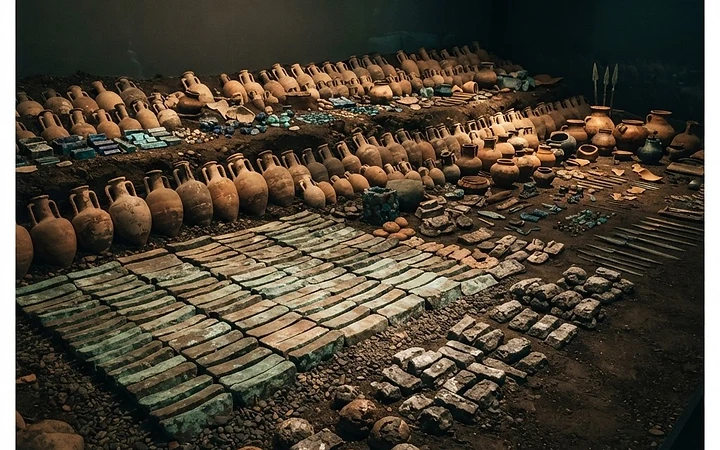
The Uluburun shipwreck is perhaps the most vivid archaeological snapshot of that system. The ship sank off the southern coast of Anatolia around 1300 BC carrying enormous quantities of copper and tin, the raw materials of bronze, together with glass, resins, ceramics, foodstuffs and luxury objects originating in different regions. What fascinates me about Uluburun is that it makes the idea of interdependence physical. There was literally a ship moving across the Mediterranean carrying the material components of an international economy. Bronze production in one kingdom could depend upon resources extracted and transported through several others. The sophistication of the network was also the source of its vulnerability.
That is where Cline’s explanation of collapse becomes most persuasive. He does not reduce the end of the Late Bronze Age to a single cause. The Sea Peoples matter, but they are not enough. Earthquakes matter, but they are not enough. Drought, famine, internal rebellion, migration and the disruption of trade all matter, but none of them by itself provides a satisfying explanation. What matters is their interaction. A drought can reduce agricultural production, which creates shortages and fiscal pressure. Shortages can weaken palace redistribution systems and increase migration or unrest. Political instability can make roads and sea routes less secure. Trade disruption can affect the availability of copper and tin. Elites whose authority depends on redistribution and international exchange can then lose both material capacity and legitimacy. A military threat arriving at that moment is confronting not a stable kingdom but a system already under stress.
The individual shock matters less than the cascade. This is why the language of systems failure feels so appropriate. The Late Bronze Age collapse becomes comprehensible not as one catastrophic blow, but as a sequence in which several dependent parts of a complex system begin failing together. Once enough nodes cease functioning, the system can no longer reproduce itself.
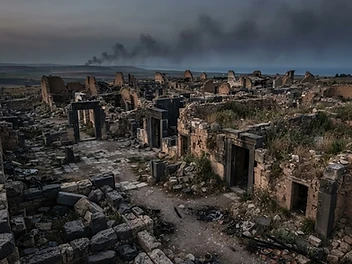
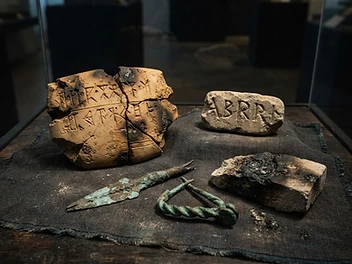
Ugarit is perhaps the most haunting example. Before its destruction, it was not a marginal city waiting to be swept away by history. It was a major commercial and diplomatic centre with archives recording contact with Egypt, Cyprus, the Hittite world, Assyria, Carchemish, Sidon, Beirut and other states. Its merchants participated in long-distance trade almost until the end. Then the tone of the evidence changes. One famous letter reports enemy ships arriving, cities burning and the land being devastated. For years it was tempting to imagine such documents almost cinematically, as messages left undelivered because destruction arrived before they could be sent. Cline is careful about that kind of reconstruction. The archaeological context of some of the tablets is more complicated than the dramatic version suggests, and that methodological caution is one of the reasons I found the book convincing. We do not need to manufacture a final scene. We know that Ugarit was violently destroyed around the early twelfth century BC, that weaponry appears in the destruction levels, that inhabitants seem to have fled quickly, and that some valuables were hidden and never recovered. A prosperous, literate, internationally connected city simply ceased to function.
Egypt provides a useful contrast because it survived. Ramesses III commemorated victories over groups identified with the Sea Peoples, and the Egyptian state did not disappear in the way Ugarit or the Hittite imperial system did. Yet survival was not the same thing as recovery. Egypt emerged weakened. The New Kingdom came to an end, central authority fragmented, and Egyptian power in the Levant contracted sharply. One of the striking implications of After 1177 B.C. is precisely that a civilisation can survive biologically and culturally while the political system that once organised it disappears.
This distinction between survival and resilience becomes the central strength of the sequel. At a distance, the post-1200 BC world can look simple: the Late Bronze Age system collapses and a poorer Iron Age world takes its place. At close range, the picture is far more uneven. Some cities are destroyed and abandoned. Others shrink but continue. Some populations migrate. Some communities retain trade even after palace administration disappears. In several cases, societies do more than survive. They exploit the new environment.
The Phoenicians are perhaps the clearest example. With Ugarit gone and the great territorial powers weakened, cities such as Tyre and Sidon operated in a radically altered strategic landscape. The collapse that destroyed one commercial system created space for another. Phoenician networks eventually extended across the Mediterranean toward Cyprus, Sicily, Sardinia, North Africa and Iberia, and alphabetic writing travelled with them. This is one of the most fascinating inversions in the story. The disappearance of highly bureaucratic palace systems did not mean the disappearance of complexity. It created the conditions for a different form of complexity based on smaller political units, flexible maritime networks and new forms of literacy.
Cyprus is equally revealing. Copper had been fundamental to the Bronze Age economy, yet the island did not simply collapse when that wider system changed. Production, settlement and exchange were reorganised. New centres emerged and technological practices shifted. What disappeared was not economic life itself but a particular configuration of political and commercial relations. Collapse, in this sense, was recombination rather than erasure.
Assyria offers a different model again. It survives the collapse, experiences contraction and pressure, and later re-expands with extraordinary force. By the first millennium BC, Assyria was filling a geopolitical vacuum left by earlier powers and developing the administrative, military and communications infrastructure of a new kind of territorial empire. The old diplomatic system of Great Kings did not return. Something else replaced it. This was not restoration but succession.
Carchemish complicates the picture further because the disappearance of the Hittite Empire did not mean the disappearance of Hittite political culture. In northern Syria and southeastern Anatolia, rulers continued to use Luwian hieroglyphs, inherited titles and political traditions. What archaeologists call the Neo-Hittite world was not simply a later imitation of a lost civilisation. In important respects it was a continuation of elements that survived the fall of the imperial centre. That distinction is essential. Empires can disappear from maps while families, administrators, cults, languages, technologies and institutions continue.
Greece is perhaps the most emotionally powerful case because the rupture was so severe. The Mycenaean palace system collapsed. Linear B disappeared. The office of the wanax vanished. Major centres such as Pylos were destroyed and never restored to their former role. Populations declined sharply in some areas, and for generations the old level of administrative complexity did not return. Yet even here the traditional image of a completely empty Greek Dark Age is too simple. Sites such as Tiryns continued to be occupied. Some construction persisted. Imported objects indicate that links with Cyprus, Egypt, Anatolia and the Levant never vanished entirely. People were living among the ruins of a political system whose institutions they no longer possessed.
That image stayed with me. They could see the monumental walls. They could reuse buildings. They could inhabit landscapes shaped by the palace civilisation. But the bureaucratic and political machinery that had created those monuments was gone. The disappearance of Linear B makes the rupture especially stark because writing itself vanished from Greece for centuries. Yet Greek civilisation did not end. When writing returned, it returned in a new form through the adoption of the Phoenician alphabet. When complex political organisation returned, it was not the reconstruction of Mycenaean palace monarchy. Eventually it was the polis.
This may be the most important lesson of reading both books together. Recovery does not mean returning to the previous equilibrium. Civilisations rarely rebuild the thing that collapsed exactly as it was. They preserve fragments, simplify institutions, migrate, borrow, forget and invent. The Bronze Age world produced part of its own fragility through its extraordinary interdependence, but the disappearance of that system did not eliminate the people who had lived within it. They adapted to new conditions and produced different political and economic forms.
That brought me back to The Odyssey. Whatever historical events lie behind the Trojan tradition, Homer remembers a world after catastrophe. Its kings are haunted by destroyed houses, murdered fathers, displaced warriors and vanished generations. Odysseus is not travelling through the confident international system represented by the Uluburun ship. He is trying to return home after the heroic world has broken itself apart. The destruction of Troy is therefore more than the capture of a city. In the Greek imagination it stands near the end of an age. Men offend gods, kings destroy kingdoms, victors fail to return, families disintegrate and the sea itself becomes hostile. Order has to be reconstructed at the level of the household.
Reading Cline after seeing the film gave archaeological substance to that intuition. It would be wrong to say that the Trojan War caused the Bronze Age collapse, or to force Homer into a literal historical reconstruction. But behind the poetry lies a real historical transformation of extraordinary scale. Palaces burned. Trade systems failed. Cities vanished. Writing disappeared in Greece. Imperial structures ceased to exist. The world of the thirteenth century BC was not the world of the eleventh.
What I liked most about reading the two books together is that they resist the temptation to treat collapse as an endpoint. 1177 B.C. is a study of systemic fragility. After 1177 B.C. is a study of adaptation. One explains how a highly sophisticated civilisation can lose coherence much faster than its inhabitants probably imagined possible. The other shows why civilisation itself does not disappear with the institutions that once organised it.
The palace can fall without ending the society that built it. A trade network can disintegrate while new routes emerge. A script can disappear while memory survives. A political order can die and leave behind the human material from which another one is eventually constructed.
That, more than the destruction itself, is what I found fascinating about the end of the Bronze Age: not simply how quickly a world could collapse, but how many different worlds could emerge from its ruins.